Essential Features in ChatGPT
A guide to the functions most useful in day-to-day work
Addressing the Limitations of ChatGPT
Training Data
Claude draws on its training data to respond to your prompt. The training data are only valid up to the published cut-off dates (May 2026 for GPT-5.6, August 2025 for GPT-5.5). To include recent information in ChatGPT’s output, you can upload additional data or request that it perform web research.
Hallucinations
Hallucinations are responses from an LLM that sound plausible but are factually incorrect or entirely fabricated.
To address the possible existence of hallucinations in ChatGPT’s responses, take the following actions:
1) Prompt ChatGPT to cite its sources
2) Prompt ChatGPT to double-check or find errors in its responses
3) Validate the truthfulness of its output manually
Remember: Critical information should be validated before usage. Do not rely on an authority you have not double-checked. Hallucination can involve fabricated research, fake statistics, and incorrect facts about people or events.
The Basics: Four Essential Features for Effective Use
Project: A workspace for one topic that holds that topic’s documents and conversations.
Context: The information that ChatGPT accounts for when answering — the provided documents, your instructions, and the conversation.
Skill: Written instructions for a repeated task; ChatGPT follows these instructions each time the task comes up.
Plug-in: A bundle of Skills and Apps that can access external systems used by GP to enable workflow automation
Projects
A Project comprises the broad instructions you have provided, the context documents you have uploaded, and the distinct chats you have begun within it.
Instructions tailor ChatGPT’s behavior and responses, allowing you to control tone, the perspective from which ChatGPT answers, and ChatGPT’s reasoning process.
Context documents inform ChatGPT’s search and synthesis efforts. Documents used throughout a project should be uploaded into the project’s context window rather than into a specific chat.
A chat harnesses the information in the project’s context window and the chat’s conversation history. Its context window is unique from those of other chats within the project. Consider opening new chats for separate tasks within a project to avoid overloading one chat’s context window.
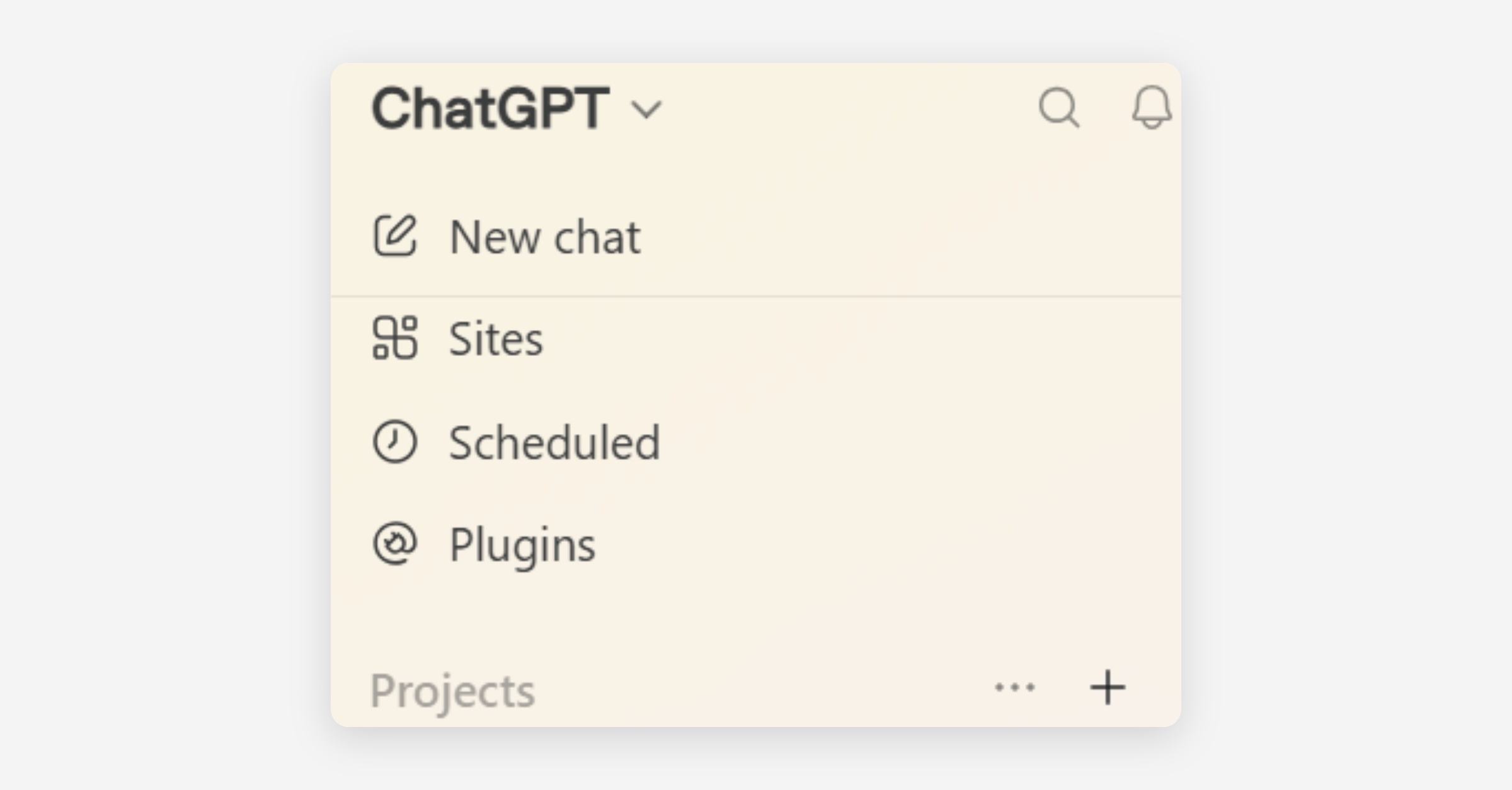
To create a Project in ChatGPT, select the ‘+’ symbol next to ‘Projects’ in the left sidebar (see image below). Decide whether you would like to run the Project in the cloud, locally, or on a remote server and add your desired files to the Project in the following menus that appear.
To add files and instructions to an existing Project, follow the listed steps:
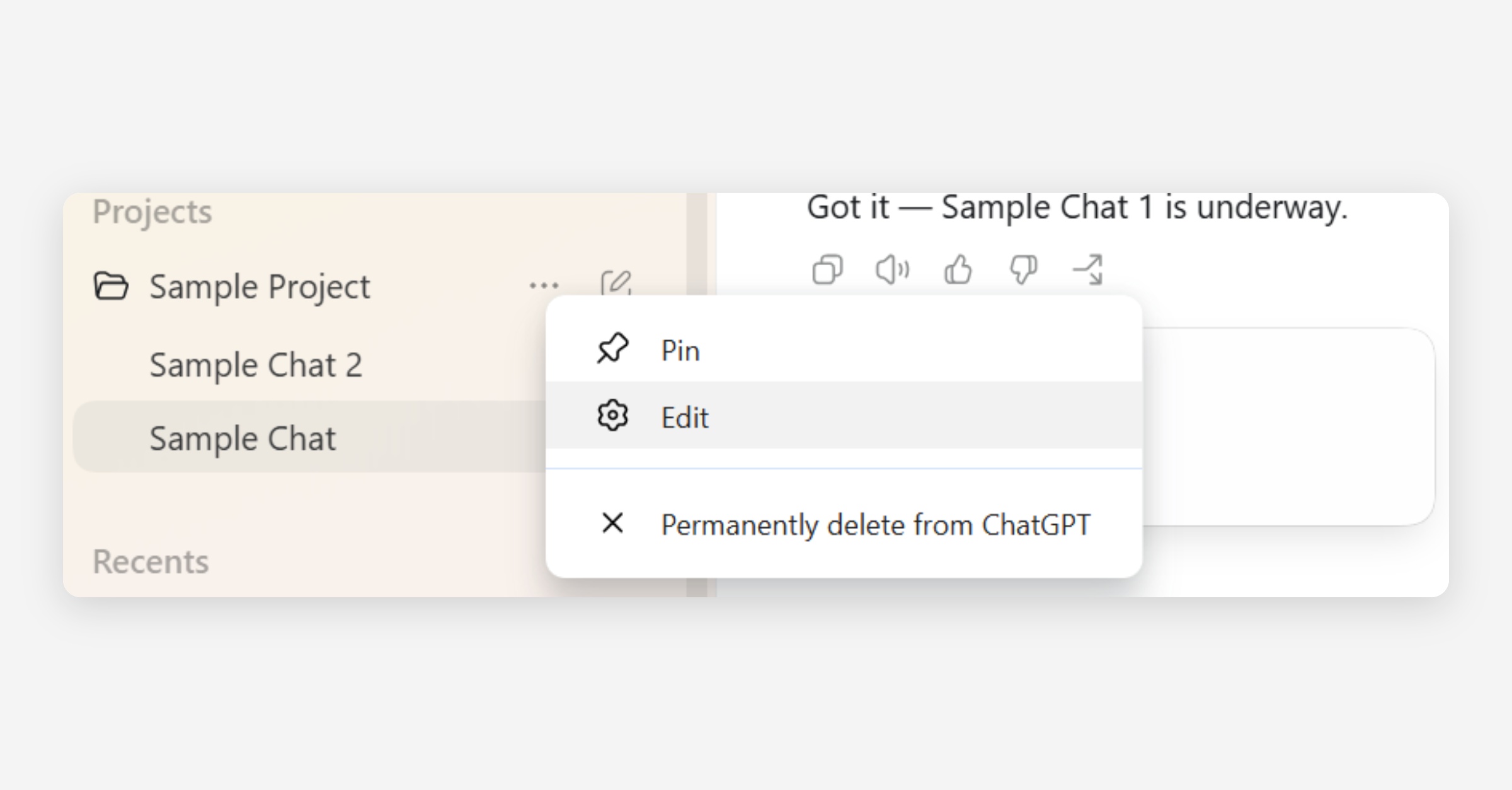
Click on the ‘…‘ next to the Project’s name in the left sidebar
Select ‘Edit’ from the drop-down menu that appears (see top image in trio below)
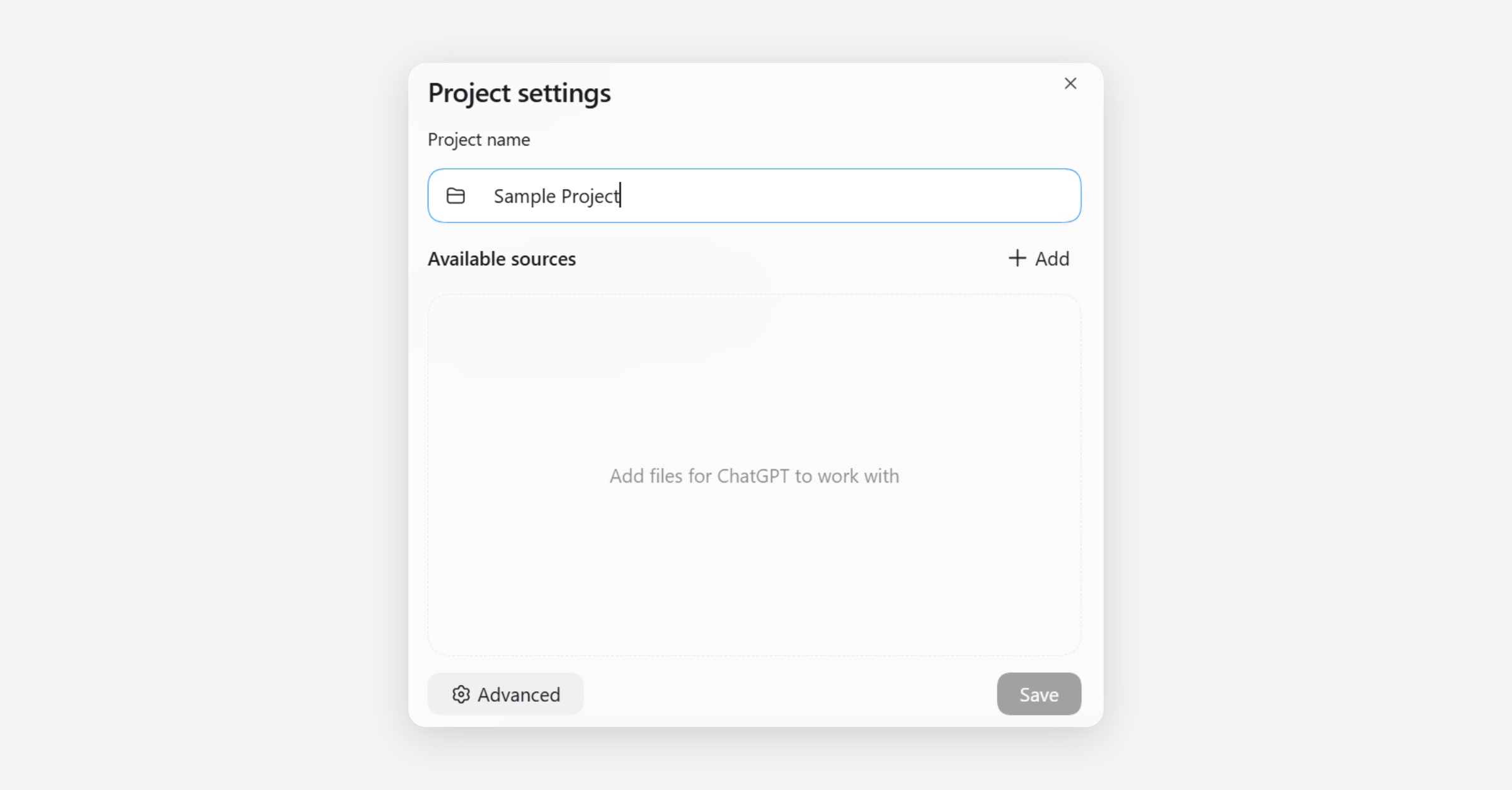
Add additional files to your existing project by clicking within the ‘Available sources’ box in the ‘Project settings’ menu that appears (see middle image in trio below)
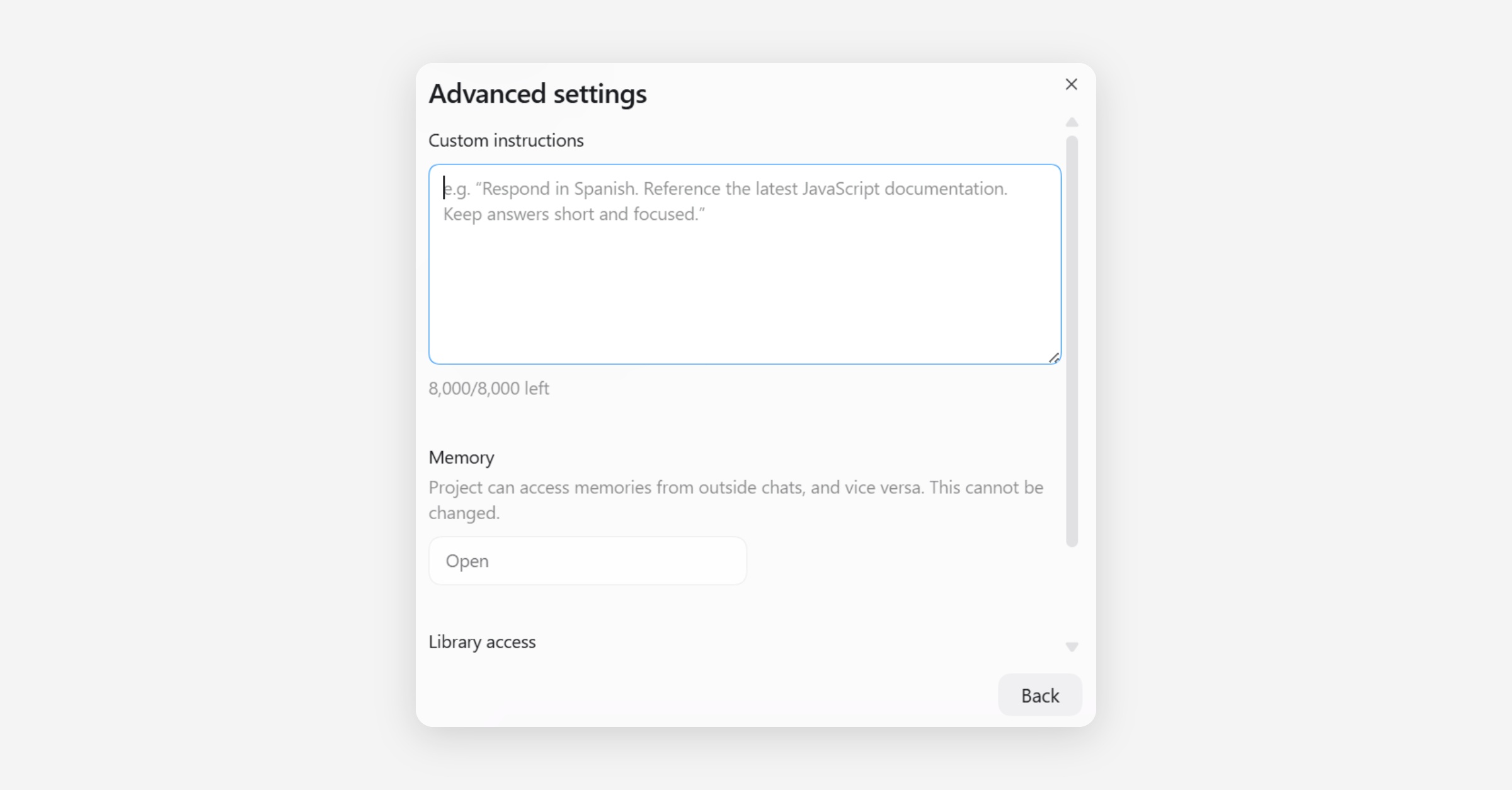
Select ‘Advanced’ in the lower left-hand corner of the ‘Project settings’ menu to view the ‘Advanced settings’ menu. From there, add project-specific instructions in the text box labeled ‘Custom instructions’ (see bottom image in trio below)
Context
Context refers to the documents held in a project or discussion, your instructions, and the conversation up to that point. This information is used to enhance the quality of ChatGPT’s output.
The context window refers to the amount of data that can be stored in context at once.
Context rot refers to the gradual degradation in output quality as the context window fills with excess or outdated information. ChatGPT’s knowledge of the information in the middle of your conversation is often the first to be lost.
To address the issue of context rot, only upload relevant information into context, and use projects rather than isolated chats.
Skills
Skills are bundles of instructions used to enhance the execution of repetitive tasks.
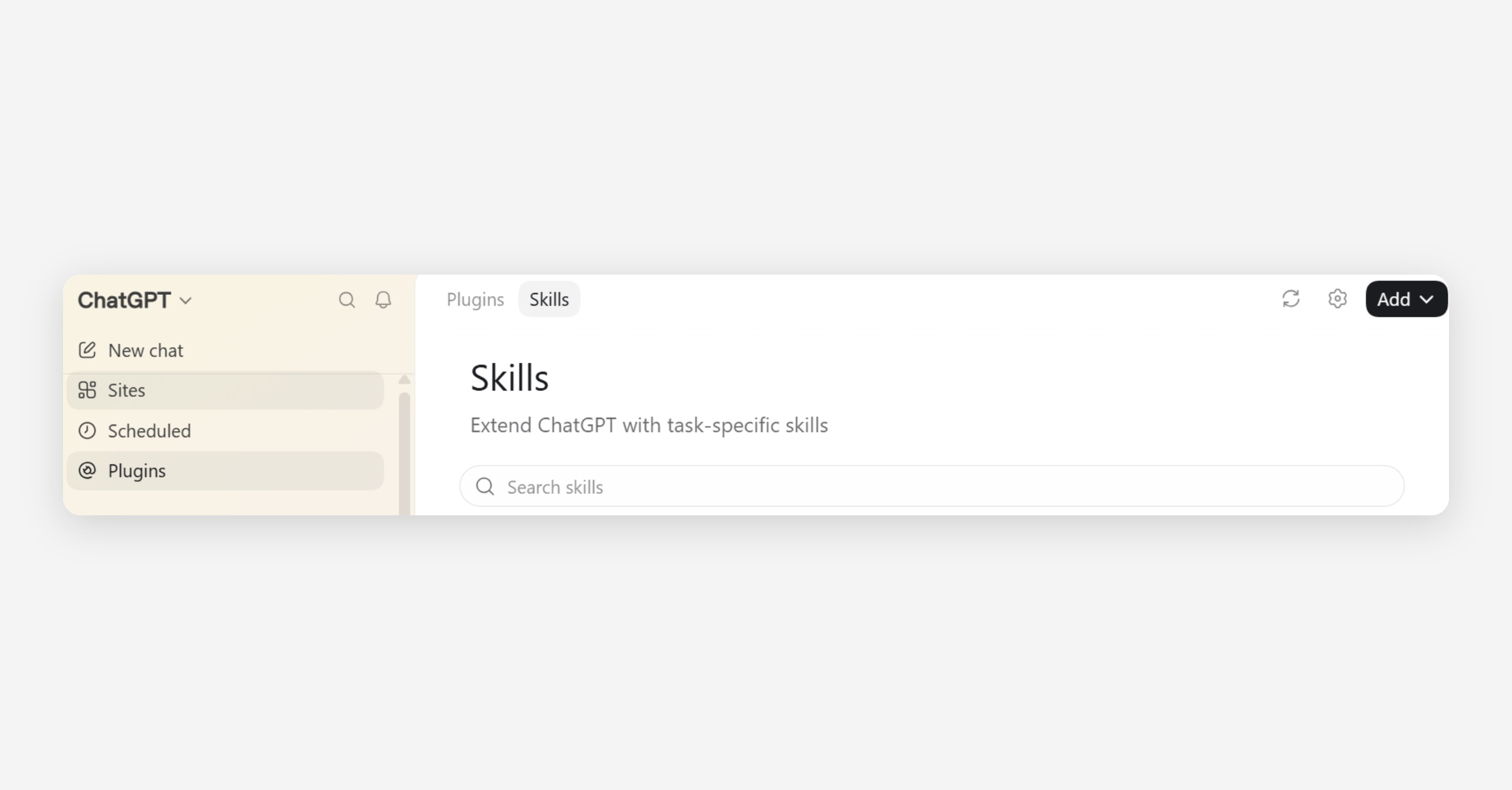
They can store workflows, institutional knowledge, and best practices. You can use skills created by ChatGPT and by GP, in addition to those you have made. To view your existing Skills, select ‘Plug-ins’ within the left-hand menu and select the ‘Skills’ option at the top of the Plug-ins page (see image below).
Developing Your Own Skills
Consider creating your own Skills to automate tasks that you perform repeatedly. A Skill should have a clear-cut purpose with a straightforward description.
To create your own Skill, navigate to ‘Add’ in the upper right-hand corner of the ‘Skills’ menu. Describe the task that you would like to automate in the chat interface that appears. The Skill Creator, visible in the chat box, will be active, and you will be provided with further instructions for installation of your Skill.
Plug-ins
A plug-in is a pre-packaged bundle of Apps and Skills and is designed for a specific workflow. It allows ChatGPT to access external data and follow custom instructions, enabling workflow automation.
Several of the available plug-in are designed for legal work. To browse through available plug-ins, select ‘Plug-ins’ in the left sidebar, and scroll through the listed plug-ins.
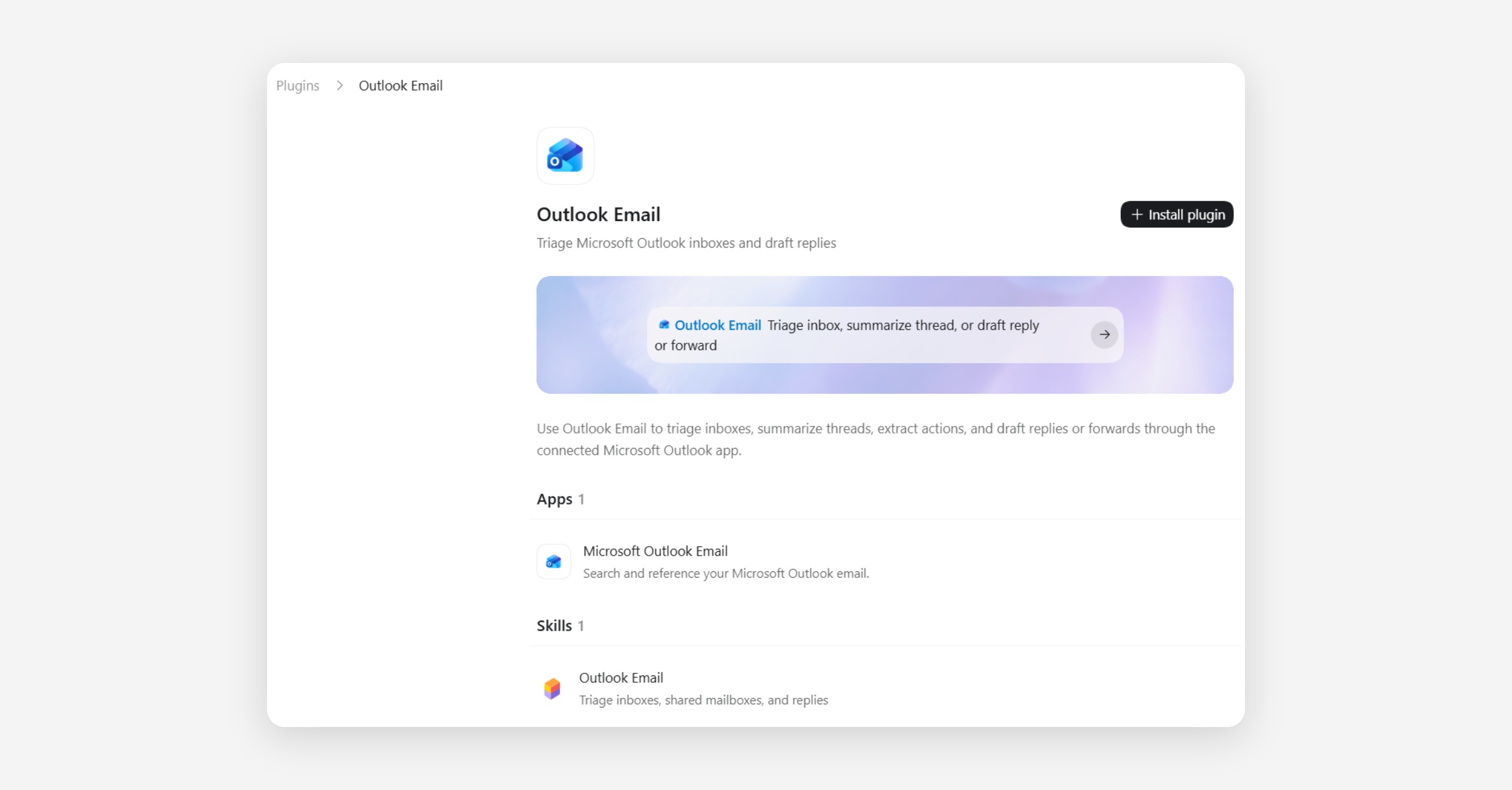
When browsing through plug-ins, click on a plug-in to view a description of the plug-in and its associated Apps and Skills (see example in image below). Select ‘+ Install plugin’ and navigate through the steps that appear in order to complete the set-up of the plug-in.
Was this helpful?